Nursery Bedding & Safe Sleep
Nursery Sleep Layers: Understanding Crib Bedding Materials and Fit
Cotton, wool, quilting, fitted sheets: nursery bedding comes with plenty of material choices and reassuring-sounding claims. But for an infant sleep space, the most important questions are simpler. Is the mattress firm, flat, and correctly sized for the crib? Is the sheet made for that mattress and fitted snugly? And does every item in the sleep space follow current safe-sleep guidance?
Published October 24, 2026
Preparing a nursery invites a thousand small decisions. A mattress cover promises protection; a quilted layer looks soft; natural fibers sound gentle and breathable. These details can make bedding feel like a matter of comfort and personal preference. For babies, though, a crib is first and foremost a sleep environment, and the materials conversation has to begin with safety—not softness, sustainability, or an appealing label.
Natural-fiber layers may differ in fiber, weave, thickness, quilting, and washing instructions. Understanding those differences is useful when choosing and caring for bedding. It does not mean every layer belongs beneath an infant. A mattress topper, padded protector, quilt, pillow, or loose blanket can change the sleep surface, and should not be added just because it is marketed for a crib or made from organic materials.
This guide explains how crib bedding is constructed, what fit checks can—and cannot—tell you, and how to read care and material labels. It is general information, not a substitute for advice from your child’s healthcare professional or the latest recommendations from recognized public-health and product-safety authorities.
Start with the safe-sleep basics
Before comparing cotton with wool or one quilt pattern with another, review current safe-sleep recommendations from the American Academy of Pediatrics (AAP), the U.S. Consumer Product Safety Commission (CPSC), and local health authorities where you live. Guidance can be updated, and requirements may vary by country. Follow the instructions supplied with the crib and mattress as well as applicable safety standards.
In general, safe-sleep guidance calls for placing a baby on their back on a firm, flat, non-inclined sleep surface designed for infant sleep, with only a fitted sheet covering the mattress. Keep the sleep space clear of soft or loose objects, including pillows, quilts, comforters, loose blankets, toys, and similar items. Do not use an inclined product or add an extra mattress layer to soften, cushion, or alter the surface.
These principles matter even when a layer is described as natural, breathable, washable, hypoallergenic, or specially made for a nursery. Such words describe material or marketing features; they do not establish that an item is appropriate for infant sleep. If you are unsure whether a product is permitted or suitable, leave it out of the crib and ask your child’s healthcare professional or the relevant safety authority for guidance.
Room-sharing—having the baby sleep in the same room as a caregiver, but on a separate, appropriate sleep surface—is commonly included in safe-sleep recommendations. It is different from bed-sharing. For the details that apply to your family, consult current clinical guidance rather than relying on a bedding label or a general article.
What “crib bedding” can mean
The phrase is broad. It may refer to the mattress itself, a fitted sheet, a mattress cover, a waterproof layer, or padded products such as a topper or quilted pad. These are not interchangeable. A fitted sheet is intended to cover a compatible mattress; a topper adds material and thickness; a protector may have its own backing or fill; and a quilted surface has layers stitched together. The words on the package do not replace a close look at construction and instructions.
For infant sleep, simplicity is important. A caregiver may encounter a range of bedding accessories in shops and online, but availability does not mean an item is recommended for use in a crib. In particular, avoid treating a plush or cushioned layer as a harmless upgrade. A baby’s sleep surface should not be made softer or thicker by adding an aftermarket product unless current guidance and the specific crib and mattress instructions clearly support its use.
It helps to separate two questions: “What is this item made of?” and “Is this item appropriate for this infant sleep space?” The first is answered by the fiber and construction details. The second requires checking safety guidance, product instructions, and the intended use of the item. A favorable answer to the first does not automatically answer the second.
Cotton and wool: material facts, not safety shortcuts
Cotton is used in many sheets and covers. It can be woven into fabrics with different weights and surface textures, from smooth percale to sateen. The weave, finishing, and garment or fabric construction all affect how a textile feels and wears. “Cotton” alone does not tell you whether a sheet fits a particular mattress, whether it is easy to launder, or whether an item belongs in a crib.
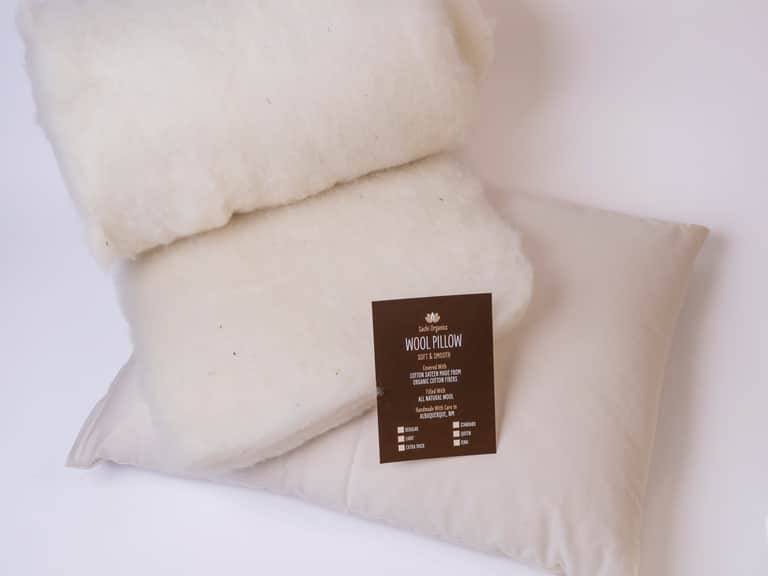
Wool is a natural animal fiber used in some bedding fills and textile blends. Its fibers can hold air and absorb moisture, which helps explain why wool appears in products intended to moderate warmth and humidity. Wool-filled items may be quilted or tufted to hold the fill in place, and some have cotton covers. Those features describe how an item is made; they do not change the need to follow infant sleep guidance.
Natural fibers are not automatically allergy-proof or risk-free for every household. People can have sensitivities to fibers, finishes, dust, or other components, and a product’s response to heat or moisture depends on its full construction. Terms such as “hypoallergenic” are not a guarantee that an individual child will have no reaction. If a baby develops a rash, breathing symptoms, or another concerning response, contact a healthcare professional.
Certification claims also need context. An organic textile certification may address certain agricultural, processing, or supply-chain requirements, depending on the standard and scope. It does not certify a mattress layer as safe for infant sleep unless the relevant safety requirements are separately met. Check what a certification covers, who issued it, and whether it applies to the complete product or only one component.
Why thickness and quilting deserve attention
Two items can be made from similar fibers and behave very differently. A single fabric sheet is thin and flexible; a quilted pad can contain a shell, batting, stitching, and sometimes a backing. The thickness, resilience, and arrangement of those layers affect how much they change the feel and height of a sleep surface. Even a product that looks modestly padded is still an added layer.
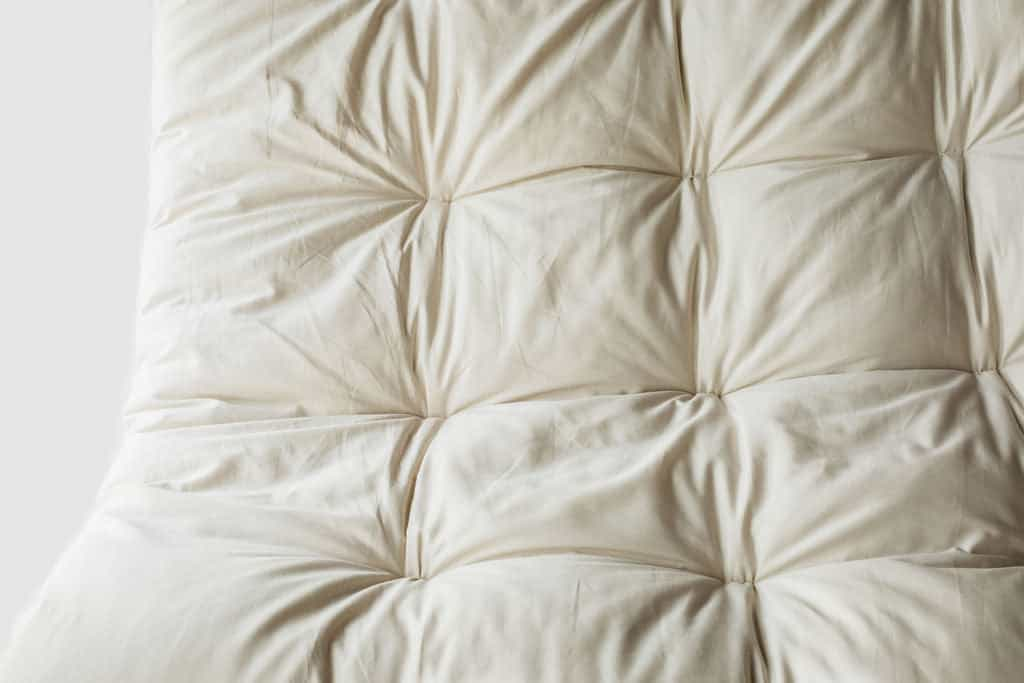
Quilting usually means that layers have been stitched together in a pattern. Stitching can help limit movement of the fill within the textile, but it does not make the product equivalent to a fitted sheet. Tufting and corner straps are likewise construction details, not proof that a padded topper should be used for an infant. Claims about temperature regulation or moisture management should not distract from the core question of whether the product is suitable for the baby’s sleep surface.
Do not try to solve a concern about a mattress being too firm by placing a softer product on top. Do not use additional padding to make an ill-fitting mattress appear more secure, or to compensate for a gap between mattress and crib. If a mattress seems damaged, unstable, unusually soft, or incompatible with the crib, stop using that setup and contact the manufacturer or a safety professional for direction.
How to assess mattress and sheet fit
A fitted sheet should be designed for the mattress dimensions and should remain securely in place when properly installed. Loose, stretched, torn, or incorrectly sized bedding can create hazards. Follow the crib and mattress manufacturers’ specifications instead of assuming that products described as “standard size” will fit every model. Measure only as directed, and check labels for the intended mattress dimensions and depth.
For the crib itself, use the mattress recommended for that model or one the manufacturer explicitly identifies as compatible. Follow the assembly instructions and inspect the crib and mattress regularly for damage, loose parts, or changes in fit. A sheet cannot correct an incompatible mattress, and a topper should not be used to fill a gap. If you see a space, movement, or fit problem that you cannot resolve by following the manufacturer’s instructions, do not improvise with extra fabric or padding.
After making the bed, check that the fitted sheet is fully secured around the mattress and that no extra bedding has been left in the sleep space. Recheck after laundering, because shrinkage, worn elastic, stretched corners, or a change in mattress configuration may affect fit. Replace a sheet that no longer stays secure or has become damaged.
These checks are practical screening steps, not a complete certification test. A snug-looking sheet does not prove that a crib setup meets every safety requirement. The full system—the crib, compatible mattress, fitted sheet, assembly, and use—matters.
Care labels: wash what the maker says you can wash
Care instructions vary even among products made from the same fiber. A cotton cover may be machine washable while its fill is spot-clean only; a quilted item may require air drying; and a wool-filled product can shrink, clump, or lose its shape if washed or dried incorrectly. The phrase “natural fiber” does not indicate a universal cleaning method.
Read the complete care label before laundering. Check the permitted water temperature, cycle, detergent, drying method, and whether parts must be removed or washed separately. Do not assume that a “washable” description applies to every component. If instructions are unclear, contact the manufacturer instead of experimenting with heat, strong cleaners, or soaking.
Clean the crib mattress and any allowed bedding according to their manufacturers’ directions. Make sure washable items are fully dry before putting them back into use, and do not put a damp or altered product into the sleep space. If a mattress is wet, soiled, damaged, or difficult to clean safely, consult its instructions and consider whether it needs replacement.
For infant sleep, laundering is not a reason to add a padded protector or another layer that is not recommended. Choose a setup that follows current safe-sleep guidance, then maintain it according to the product labels. If repeated spills or nighttime accidents are a concern, ask a healthcare professional or safety authority about options that are appropriate for your specific sleep surface.
A practical label-reading checklist
When evaluating any nursery bedding item, pause over both the material information and the instructions for use. Clear product documentation should help caregivers identify what the item is, what it contains, and how it is intended to be used. If the description relies on vague language or does not identify a compatible mattress, seek clarification before using it.
- Identify the item: Is it a fitted sheet, cover, protector, pad, or topper? Do not treat those terms as synonyms.
- Read the full fiber content: Note the shell, fill, backing, and any blended fibers rather than relying on a headline description.
- Check intended use: Look for explicit manufacturer instructions for the exact crib and mattress configuration.
- Verify dimensions: Compare the sheet’s stated size with the mattress specifications and follow the crib maker’s fit instructions.
- Review safety information: Check applicable product standards, recalls, and guidance from relevant authorities.
- Understand care limits: Confirm whether the entire product is washable, how it must be dried, and whether the fill can be laundered.
- Keep the sleep space clear: If an item is not allowed by current recommendations, do not use it in the crib, regardless of its material or certification.
Common nursery bedding myths, gently untangled
“Natural means safer.” Natural describes a material’s origin, not the safety of every product design. A natural-fiber quilted pad still adds a layer. The item’s intended use, construction, compatibility, and relevant safety guidance all matter.
“Breathable means it belongs in the crib.” Breathability claims are not a substitute for safe-sleep recommendations. Do not use a product simply because its packaging suggests airflow or temperature balance.
“A snug fit makes any layer acceptable.” Fit is important for the mattress and fitted sheet, but a tight attachment does not change the nature of a padded topper or make an unapproved item appropriate.
“Organic certification is a safety approval.” Certifications can be meaningful, but their scope is specific. Organic status does not, on its own, establish that a product is safe for infant sleep.
“A little extra softness is harmless.” A baby’s sleep surface should not be modified for adult preferences. Follow current guidance and avoid adding cushions, padding, or loose bedding.
When to pause and ask for help
Caregivers should not have to guess whether a product is compatible with a crib. If the packaging is unclear, the mattress dimensions do not match the crib instructions, the sheet will not stay in place, or a product appears to change the surface, pause before using it. Contact the crib or mattress manufacturer for product-specific information, and consult a pediatric healthcare professional for questions about the baby’s sleep needs.
Check official recall databases and safety notices where you live, especially when using secondhand equipment. A product may have an age limit, model-specific restriction, or recall that is not obvious from its appearance. Do not use equipment with missing labels or instructions if you cannot establish that it is safe and compatible.
For babies with medical needs, prematurity, or particular temperature-regulation concerns, get individualized clinical guidance. General advice about fibers cannot replace care tailored to a child’s health. Avoid relying on a bedding seller’s broad wellness claims as medical advice.
The simplest sleep layer is often the clearest choice
Natural-fiber bedding can be interesting to compare: cotton and wool differ in feel, moisture behavior, construction, and care. Those distinctions are useful for understanding textiles and looking after household bedding. But nursery sleep decisions call for a different order of priorities. First establish a safe, compatible crib and mattress. Then use only the bedding that current guidance and the manufacturers’ instructions permit.
In practical terms, focus on a firm, flat infant sleep surface, a correctly fitted sheet, and an uncluttered crib. Treat toppers and quilted pads as added layers—not as automatic upgrades—and do not allow a material claim to override safe-sleep advice. When a label or fit question leaves room for doubt, leave the item out until you have reliable, product-specific guidance.